
About this Event
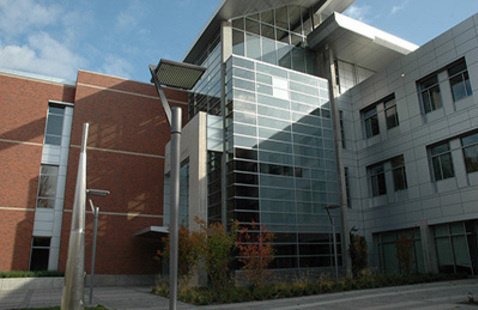
2461 SW Campus Way, Corvallis, OR 97331
New Detection methods for Transmission at Faster-Than-Nyquist Rates Using Quasi-Orthogonal Sequences
Direct sequence spread spectrum (DSSS) was initially used for anti-jamming in military applications and was later developed in other commercial applications. Walsh codes, which are a set of mutually orthogonal codes, are one type of the spreading code used in DSSS systems. For any spreading codes of length N, these exist exactly N mutually orthogonal spreading codes; applying more than N codes to transmit data simultaneously will introduce interference among the transmitted data. For interference-free detection, the symbol rate is thus bounded by the Nyquist transmission rate with DSSS codes, assuming the traditional correlation receivers. The goal of this thesis is to explore new detection methods for signaling with faster-than-Nyquist transmission rates. First, new sets of quasi-orthogonal codes are designed to allow simultaneous transmission of data with more than N codes of length N each. Thus there existing mutual interference among the transmitted data. Then, a multi-layer perceptron (MLP) detection scheme with three layers is proposed for detecting the signal transmitted at faster-than-Nyquist rates using the quasi-orthogonal DSSS sequences. Finally, a long short time memory (LSTM) is proposed for detection in the proposed signaling scheme. The performances of these schemes are analyzed and simulated, and compared with the traditional correlation detection schemes.
Major Advisor: Huaping Liu
Committee: Jinsub Kim
Committee: Bechir Hamdaoui
GCR: Bo Zhao